Faculty Origin

Faculty of Applied Arts (1839 – 2025)

◆ The origins of the Faculty of Applied Arts, as a scientific institute in the modern era, trace back to the School of Arts and Royal Industries, established by Mohamed Ali Pasha in 1839 in Bulaq under the name School of Operations. At that time, it specialized in training practical engineers and skilled technicians.

Later, it became known as the School of Arts and Royal Industries when Mohamed Ali Pasha recognized the urgent need to prepare practical engineers and trained technicians to meet the country's demand for establishing factories, preparing commercial ships and naval fleets, and constructing essential facilities for Egypt’s development.

Throughout its long history, the school underwent numerous modifications and reforms to keep pace with evolving societal needs. By the 1908-1909 academic year, the School of Arts and Royal Industries comprised three departments:

  1. Mechanical and Electrical Engineering
  2. Building and Urban Planning
  3. Decorative Arts and Industries

In 1910, a Cabinet decree established new regulations confirming this system, setting a five-year study period, including four academic years and a final year for practical training. The third department (Decorative Arts and Industries) was divided into three specialized divisions:

  • First Division: Textile, Dyeing, and Carpet Weaving
  • Second Division: Engraving, Carving, and Carpentry
  • Third Division: Decorative Metalwork

The first group of students from this department graduated in 1913. By the 1918-1919 academic year, the Decorative Arts and Industries Department became independent, forming a separate school. The Englishman William Stewart, then Deputy of the Royal School of Arts and Industries, was appointed as its director.

The new school was located in Fadel Pasha Al-Dramalli’s Palace in Hamzawy, Cairo, and was named the Egyptian School of Arts and Ornamentation. It maintained the same three divisions, now converted into independent academic departments. The study duration remained five years, with the final year dedicated to industrial training and practical application in factories and production units. Graduates were awarded a diploma in one of the three specialized fields.

◆ In 1928, William Stewart left, and his compatriot John Edney took over as director. He relocated the school to its current site at the Orman Palace in Giza and renamed it the School of Applied Arts. Edney introduced curriculum reforms, including the establishment of a Preliminary Section that accepted students with a primary school certificate. This section had a three-year study program, culminating in a diploma in one of ten industrial specializations, according to the following structure:

  • Woodworking, Engraving, and Antiques
  • Textile Weaving and Dyeing
  • Textile Printing
  • Stained Glass with Lead
  • Engraving and Ornamentation
  • Ceramics
  • Decorative and Industrial Metalwork
  • Decorative Ironwork
  • Photography
  • Watchmaking

Note: The watchmaking specialization was later transferred to the Mechanical Industries School due to the difference in its technical nature. 

◆ In 1933, some specializations were merged, and a new Higher Section (Third Section) was introduced. Admission to this section was restricted to graduates of the Preliminary Section and outstanding students from three-year industrial schools. After three years of study, students were awarded a diploma. The first class graduated in 1935, and the last class under this system graduated in 1944.

This section included eight specializations:

  • Furniture (Woodworking) and Wood Engraving
  • Textile Printing, Carpets, and Kilims
  • Glass and Ornamentation
  • Silverwork and Decorative Metalwork
  • Ironwork and Decorative Enamel
  • Textile Weaving and Dyeing
  • Ceramics
  • Photography 

◆ In 1934, Mohamed Bek Hassan El-Sherbini became the first Egyptian director of the school. He led efforts to Egyptianize its administration and faculty, replacing the many foreign professors and artists who had previously taught at the institute, coming from England, France, Italy, Russia, and Germany.
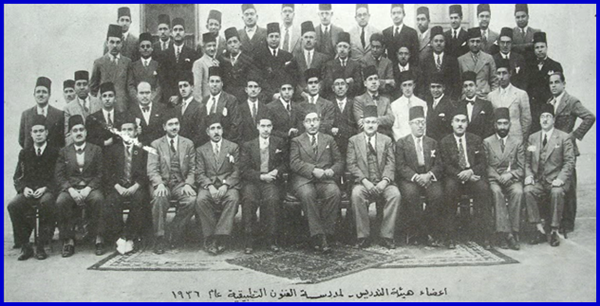

Picture1

In 1937, a New System Was Introduced

In 1937, a modern system was introduced at the school, admitting students who had obtained a General Culture Certificate, provided they passed the artistic aptitude test, which had been in place since the school's early stages. The study duration remained three years, after which students received a diploma in Applied Arts.

Students who excelled in their diploma studies could pursue an additional two years of specialized study, leading to a Specialized Diploma in one of the following four fields:

  • Textiles
  • Metals
  • Decorative Antiques
  • Furniture

Transformation into the Higher School of Applied Arts (1941)

In 1941, a ministerial decree renamed the school to the Higher School of Applied Arts, with a new set of admission requirements:

  1. Applicants must have successfully completed at least three years in secondary schools.
  2. Applicants must have been promoted to the fourth year of five-year industrial schools.

In both cases, students were required to pass the artistic aptitude test. The study period was set at five years, and the first specialized class graduated in 1946 in the initial four disciplines. In 1947, a fifth specialization was added—Photography.

Revised Admission Requirements (1946)

In 1946, the admission criteria were revised to include:

  1. General Secondary Education Certificate (General Section)
  2. Diploma from Industrial Secondary Schools (Five-Year System)
  3. Equivalent Culture Certificate, provided students passed the artistic aptitude test.

At that time, the school offered five departments:

  • Decoration, Stained Glass, and Ceramics
  • Furniture, Interior Design, and Sculpture
  • Textiles and Textile Printing
  • Metals and Ironwork
  • Photography

The study period remained unchanged, and the first class under this system graduated in 1951.

Transition to the Higher Institute of Applied Arts (1949-1950)

On December 14, 1949, a ministerial decree was issued to regulate higher institutes under the Ministry of Public Education, including the Higher Institute of Applied Arts.

On December 19, 1950, the school was renamed the Royal College of Applied Arts, while maintaining its existing study system.

Renaming to the College of Applied Arts (1953)

After the July 1952 Revolution, a decree was issued on December 22, 1953, changing the name to "College of Applied Arts," which remains its name today.

The admission criteria were also modified, allowing only students with a Specialized Secondary Education Certificate or its equivalent, provided they passed the competitive entrance exam.

At this point, the specializations were restructured into:

  • Interior Design and Furniture
  • Decoration, Stained Glass, and Advertising
  • Textiles and Dyeing
  • Precision Metals and Medals
  • Textile Printing
  • Decorative Ironwork and Artistic Casting
  • Ceramics and Faience
  • Photography and Cinematography
  • Sculpture
  • Mechanical Photography (Zincography and Lithography)

The study period remained unchanged, and the first class under this system graduated in 1958.

First Female Students Admitted (1956-1957)

During the 1956-1957 academic year, the college began accepting female students for the first time. The first female graduates completed their studies in 1961, marking a milestone in allowing Egyptian women to participate in all artistic and technical fields.

Changes in Admission Requirements (1958-1959)

In 1958-1959, the admission requirements were modified to accept students with one of the following qualifications:

  1. General Secondary Education Certificate (Science Section)
  2. Diploma from Industrial Secondary Schools
  3. Home Economics Secondary Education Certificate

Students were still required to pass the artistic aptitude test.

Additionally, the study period was reduced from five years to four, with the possibility of extending it by one year upon a decision by the Minister of Education. Educational studies were introduced into the curriculum.

However, this system lasted only two years, proving unsuccessful. Consequently, the five-year study period was reinstated.

Expansion and Specialization (1961)

In 1961, the Decoration, Stained Glass, and Advertising Department was divided into three independent departments, and a new department—Industrial Design—was introduced, bringing the total to thirteen departments:

  • Precision Metals
  • Ironwork
  • Ceramics
  • Furniture
  • Decoration
  • Sculpture
  • Textiles
  • Textile Printing
  • Photography
  • Mechanical Photography
  • Glass
  • Advertising
  • Industrial Design

Establishment of Graduate Studies (1968-1969)

In 1968-1969, the college introduced graduate studies for the first time, aiming to align with modern scientific methodologies and develop applied arts education.

  • The first Master’s degree in Applied Arts was awarded in 1971.
  • The first PhD in Applied Arts was awarded in 1977.

Integration into Helwan University (1975)

On July 26, 1975, Helwan University was established under Decree No. 70 of 1975, comprising twenty-one faculties, with the College of Applied Arts as its oldest institution.

Helwan University was founded as a technological university, organizing its faculties based on scientific divisions grouped into specialized colleges. Consequently, the study system at the College of Applied Arts was restructured, forming four scientific departments in 1975:

  1. Industrial Design Department
  2. Interior Design Department
  3. Textiles Department
  4. Photography and Printing Department

Each department included several subspecialties that were previously independent departments. This restructuring aimed to strengthen faculty resources and enhance teaching capabilities to meet the requirements of a university-level education system.

The specialized departments and their subdivisions were as follows:

1. Industrial Design Department

  • Metals
  • Ironwork
  • Machinery and Equipment
  • Ceramics
  • Glass

2. Interior Design Department

  • Interior Design and Furniture
  • Applied Decoration
  • Applied Sculpture

3. Textiles Department

  • Spinning, Weaving, and Knitting
  • Textile Printing, Dyeing, and Finishing

4. Photography and Printing Department

  • Photography, Cinema, and Television
  • Mechanical Photography and Printing
  • Advertising

Curriculum Modernization (1997)

In 1997, the college curriculum was modernized to align with 21st-century developments and workforce demands. The specialized divisions were restructured into thirteen independent departments, refining their scientific identity and enhancing integration with specialized applied sciences.

Additionally, a new department was introduced: Ready-Made Garments, increasing the number of scientific departments to fourteen. This expansion aimed to prepare graduates with deeper expertise, fostering innovation and direct industry engagement.

Later, seven specialized programs were introduced under a self-funded system, providing students with broader opportunities to acquire market-relevant skills and practical expertise.

The final structure of departments and academic programs is as follows:

  1. Photography, Cinema and Television
  2. Print, Publishing and Packaging
  3. Advertising
  4. Interior Design and Furniture
  5. Industrial Design
  6. Furniture & Metal Constructions Design
  7. Metal Products and Jewelry
  8. Ceramics
  9. Glass
  10. Decoration
  11. Sculpture & Architectural Formation
  12. Spinning & Weaving
  13. Printing Textiles, Dyeing & Finishing
  14. Apparel
  15. Furniture Design Science
  16. Digital Advertising Design
  17. Fashion and Textile Printing
  18. Multimedia Printing
  19. Packaging Science
  20. Design and Formation of Glass in Architecture
  21. Ecological Interior Design


جامعة حلوان

Helwan University strives to be a leading educational and research institution in technology and the arts, and excels in education and sciences according to international quality standards

  • Visits 41647
جامعة حلوان